Tampilkan postingan dengan label rafflesia mira. Tampilkan semua postingan

Kamis, 27 Maret 2008

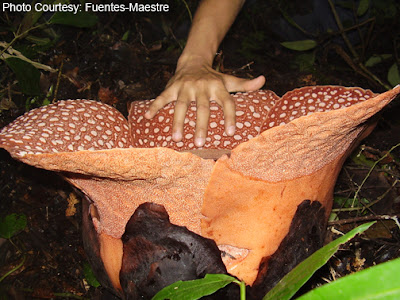
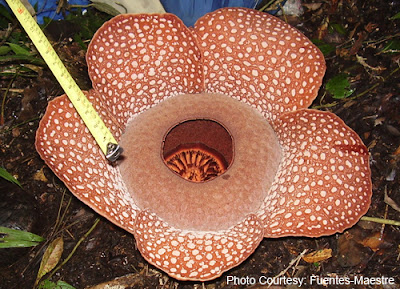
The Best Photo of Rafflesia Mira

R. mira (MINDANAO)

R. mira (MINDANAO)


The world's largest flower, now blooming at Sibalom Natural Park in Antique

The largest flower
Posted on 27 February, 2005 - 4:46am.

The world's largest flower, now blooming at Sibalom Natural Park in Antique


by Art Fuentes


To see the world’s largest flower for the first time is to encounter a life form so strange, it makes you wonder if you’re in the presence of something from a different planet or era. The Rafflesia is completely unlike any bloom you have ever seen, or for that matter will ever see.

The flower exists, without the usual parts we have come to associate with flowers, or even plants—no stem, no branch, not even leaves. Then there is also the matter of its size which ranges in diameter from a cabbage head to a car tire. The Rafflesia is the veritable T-Rex of the world of blossoms. And because of all its strangeness, the Rafflesia is an awe to behold.

What is the Rafflesia?
The flower is named after its European discoverer Thomas Stamford Raffles. First discovered in Sumatra in 1818, twenty Rafflesia species have been found so far in different parts of Southeast Asia. Many of the species are extremely rare, and have been recorded from only a handful of localities.

The flower is actually a parasite. It grows within its host, the tetrastigma vine, and in its early stages appears as but a tangle of fibers. It only starts manifesting itself during its reproductive cycle. Outgrowths appear on the root vine (1), then cabbage-like buds develop (2), then a fully open flower blooms (3) and bears fruit. The flowers themselves take a long time to develop.


From the time the bud appears, it can take 9-10 months for the flower to bloom. Not all buds bloom into flowers, a lot of buds decay before they can even open. Too much rain causes the buds to rot, while too little rain causes them to shrivel up and dry.

Lifecycle
Each flower is either male or female. Female flowers are rare, and of these, fewer still are fertilized. The flowering episode itself is brief, and will last no more than a couple of days. Once in bloom, the flower releases a putrid scent that attracts flies and other insects that serve to pollinate it. For a female flower to get pollinated, a male flower must be nearby and also in bloom.
After a period of 3-5 days, whether or not they are successful at pollination, the flowers begin to wither and turn black. If the female flower was successfully pollinated, it will bear fruits that get buried somewhere near the bottom, waiting to be picked up by forest rats, insects or other animals. Finally, for the seeds to form another bloom, they need to find their way to the right kind of vine.

Despite significant scientific research, many aspects of the Rafflesia’s biology have yet to be figured out. We still do not know how its seeds germinate and grow and we have no idea why the Rafflesia associates itself with the tetrastigma vine.

Uroy
There are currently three known species of the flower here in the Philippines. Rafflesia manillana can be found in Luzon, most prominently in Mt. Makiling in Laguna and Mt. Isarog in Bicol. The second species—Rafflesia schadenbergiana, was discovered in Mt. Apo in Mindanao in 1882, but has since never again been seen. It is probably already extinct.
IPB Image
Pictures from Haribon Philippines:

Sibalom Natural Park, Antique- home of the newest largest flower

The third Philippine species of the flower can be found in Southern Panay. Named Rafflesia species novum, it also the newest species of the giant flower to be discovered. Locally known as uroy, the Rafflesia has long been familiar to the residents of Mt. Porras in the towns of Sibalom and San Remegio, Antique. However, it was only in 2002 that the uroy was confirmed to be a distinct species. The newly-established Sibalom Natural Park quickly adopted the new Rafflesia species as its flagship attraction.

The discovery of the new Rafflesia species caused a sensation in the province of Antique. The discovery was reported in both the national and local dailies. A lot of visitors trooped to Sibalom Natural Park to see the giant flowers.

The uroy has great potential to be a major ecotourist attraction for the Sibalom Natural Park. However, steps must be taken to protect the flower from being overwhelmed by the influx of sightseers.

What are the threats to this species?
The Rafflesia is obviously a very sensitive living thing. The survival of the plant depends on a lot of factors—the seeds need to find the right host, the buds need to receive the right amount of water and nutrients, and flowers of the opposite sex must be near by so that pollination can occur.

In Malaysia, where the flowers have been star attractions in natural parks for years, park authorities have instituted measures to minimize the impact of tourism on the survival of the flowers. They found that a lot of buds failed to bloom when disturbed. Efforts at cultivating the flower have also met little success.

While ecotourism must be carefully controlled, by far the most significant threat to the Rafflesia is the destruction of its habitat. The Rafflesia depends on the rainforest to survive. Across the Philippines, rainforests are being felled due to logging, mining, and the conversion of forest lands for commercial and residential uses. If these forests are destroyed, the Rafflesia may also cease to exist—along with other unique and irreplaceable Philippine flora and fauna.

http://www.asiafinest.com/forum/lofiversion/index.php/t70747.html

Senin, 17 Maret 2008

Rafflesia mira Fernando and Ong

Rafflesia mira Fernando and Ong

The specific epithet derives from the Spanish word "mirar" which means "to look" or "look at", referring to the wonderful and surprising discovery of this new species.

This species was recently described and named in the following:

Fernando, E. S., and P. S. Ong. 2005. The genus Rafflesia R. Br. (Rafflesiaceae) in the Philippines. Asia Life Sciences 14: 263-270.

Later, another group published the following:

Madulid, D. A., D. N. Tandang, and E. M. G. Agoo. 2005. Rafflesia magnifica (Rafflesiaceae), a new species from Mindanao, Philippines. Acta Manilana 53: 1-6.

Both of these Rafflesia taxa derive from Mt. Candalaga, Compostela Valley, Mindanao Island in the Philippines and the descriptions are similar, thus they represent the same taxon. The Fernando et al. (2005) publication is being followed here because it circulated December 2005 whereas the Madulid et al. publication circulated July 2006 (despite the date given on the paper as 2005). Therefore, R. mira has nomenclatural priority and R. magnifica becomes a synonym.


A flower at peak anthesis. Photo courtesy of Edwino Fernando.

Rafflesia mira with woman

Just the flower (from above photograph). Photo courtesy of Edwino Fernando.

Rafflesia mira flower

Two slightly senescent Rafflesia mira flowers. Photo courtesy of Edwino Fernando.

Rafflesia mira sensescent flower


SIUC / College of Science / Parasitic Plant Connection / Rafflesiaceae
URL: http://www.parasiticplants.siu.edu/Rafflesiaceae/Raff.mira.page.html
Last updated: 06-Nov-06 / dln

Rabu, 05 Maret 2008

Raffesia mira: yet another reason to be proud of the Philippines!

Raffesia mira: yet another reason to be proud of the Philippines!
Posted on 5 April, 2006 - 12:17pm.

Rafflesia manillana ( Photo: Benito Tan, Vanishing Treasures of the Philippine Rain Forest by L. Heaney and J. C. Regalado, Jr.)

By Art Fuentes
A biologist once said that for every species named, there’s still another four or five waiting to be discovered.
Some people may see this remark as an article of faith rather than a statement of fact. But sometimes keeping faith has its rewards.
Another species of the rare giant flower Rafflesia was discovered here in the Philippines. Filipino scientists led by Dr. Edwino Fernando and Dr. Perry Ong trooped to a remote mountain in the town of Maragusan, Campostela Valley Province in Mindanao. They came to verify a story that was until then mere rumor—another species of the strange bloom was growing there.
It was true. The scientists, overcome perhaps with their own discovery, named the new plant Rafflesia mira. Their discovery is made even more astonishing when considered that barely three years ago in 2002, another species of the extremely rare plant was found in the mountains of Antique province. Named Rafflesia speciosa, the rare flower has since been adopted as the official symbol of the Sibalom Natural Park and the municipality of Sibalom in Antique Province.
R. mira is the fourth Rafflesia species identified in the country, along with R. speciosa, and R. manillana. Another species, R. schadenbergiana was last recorded in 1882 in Mt. Apo in Davao. It has not been seen for more than a century and is now believed to be extinct.
If it is true that for every species named, there’s still another four waiting in line, then we really have barely scratched the surface, as shopworn as that may sound.


Rafflesia speciosa

Strange bloomThe Rafflesia is completely unlike any bloom you have ever seen, or for that matter will ever see. Unlike other flowers that are just parts of plants, the Rafflesia flower is the plant itself.
It also exists, without the usual parts we have come to associate with flowers, or even plants—no stem, no branch, not even leaves. But its real strangeness lies in its size, these blooms range in diameter from a cabbage head to a car tire. Finally, instead of the pleasant scents we’ve come to normally identify with flowers, most of these giant blooms emit a foul rotting odor.
Rarest of the rareThe flower is named after its European discoverer Thomas Stamford Raffles. First discovered in Sumatra in 1818, more than twenty Rafflesia species have been found so far in different parts of Southeast Asia. Many of the species are extremely rare, and have been recorded from only a handful of localities.
The flower is actually a parasite. It grows within its host, the tetrastigma vine, and in its early stages appears as but a tangle of fibers. It only starts manifesting itself during its reproductive cycle. Outgrowths appear on the root vine (1), then cabbage-like buds develop (2), then a fully open flower blooms (3) and bears fruit. The flowers themselves take a long time to develop.
From the time the bud appears, it can take 9-10 months for the flower to bloom. Not all buds bloom into flowers, a lot of buds decay before they can even open. Too much rain causes the buds to rot, while too little rain causes them to shrivel up and dry.
LifecycleEach flower is either male or female. Female flowers are rare, and of these, fewer still are fertilized. The flowering episode itself is brief, and will last no more than a couple of days. Once in bloom, the flower releases a putrid scent that attracts flies and other insects that serve to pollinate it. For a female flower to get pollinated, a male flower must be nearby and also in bloom.
1
2
3
4

Photo: Manila Bulletin
After a period of 3-5 days, whether or not they are successful at pollination, the flowers begin to wither and turn black. If the female flower was successfully pollinated, it will bear fruits that get buried somewhere near the bottom, waiting to be picked up by forest rats, insects or other animals. Finally, for the seeds to form another bloom, they need to find their way to the right kind of vine.
R. mira, a remarkable and surprising discovery.


Rafflesia mira (Fernando and Ong sp. nov.) in Mt. Candalaga, Campostela Valley Province, Mindanao.Reprinted from Asia Life Sciences G14(2):269, 2005. Photo by Rhonsan Ng


New discoveryWhat could possibly be the smallest of the largest species of Rafflesia in the Philippines was recently discovered in Mt. Asog in Camarines Sur. It measures 12-13 cm in diameter. The discoverer, a group of researchers from the Camarines Sur State Agricultural College, proposed that the species be named Rafflesia irigaenses. (Photo courtesy of CSSAC)

R. mira probably deserves its grandiose name. It measures between 22 cm and 29 cm in diameter, much larger than Antique’s R. speciosa which measures 18-20 cm, and definitely larger than Luzon’s R. manillana which spans a mere 14-20 cm in diameter. (It’s the smallest of its kind, but try placing it next to a rose!).
According to Dr. Fernando and Dr. Ong in their article published in the Asia Life Sciences journal (14[2]:2005), R. mira was first seen and photographed in Mt. Candalaga in Campostela Valley Province. They added that it is similar to R. speciosa in size and dimension, but differs in wart distribution and pattern.
The National Museum has already coordinated with Maragusan’s local government to develop a conservation plan for the new plant species. It is feared that curious people might troop to the forest and accidentally destroy the fragile flowers, their buds or the Rafflesia’s host-vines.
What are the threats to this species?The Rafflesia is obviously a very sensitive living thing. The survival of the plant depends on a lot of factors—the seeds need to find the right host, the buds need to receive the right amount of water and nutrients, and flowers of the opposite sex must be nearby so that pollination can occur.
In Malaysia, where the flowers have been star attractions in natural parks for years, park authorities have instituted measures to minimize the impact of tourism on the survival of the flowers. They found that a lot of buds failed to bloom when disturbed. Efforts at cultivating the flower have also met little success.
While ecotourism must be carefully controlled, by far the most significant threat to the Rafflesia is the destruction of its habitat. The Rafflesia depends on the rainforest to survive. Across the Philippines, rainforests are being felled due to logging, mining, and the conversion of forest lands for commercial and residential uses.
The discovery of R. mira and R. speciosa demonstrates the need to preserve what’s left of our natural forests. If things as rare and unique as these plants can be discovered within years of each other, who knows what else we can find in our forests?


http://www.haribon.org.ph/index.php?q=node/view/342


Template Design By:
SkinCorner/laudean