Rafflesia speciosa Barcelona and Fernando
In 2002 a Rafflesia was seen blooming on the island of Panay, Antique province, Sibalom Natural Park (SNP) near the town of Sibalom. Sightings were also been reported in the adjacent town of San Remegio (also in Antique province) and nearby barangays at the Antique-Iloilo border. Up to this point in time, two species of Rafflesia had been described from the Philippine islands: R. manillana from the island of Luzon (Mt. Maquiling) and R. schadenbergiana from Mindanao (Mt. Apo). The latter species had not been seen since 1882 when it was first collected (Hieronymus s.n.). The plant was described by Göppert in 1885 whereas R. manillana was named by Teschemacher in 1842. These two species are easily distiguished from each other: R. manillana has a flower 15-20 cm in diameter (the smallest of all Rafflesia species) whereas the flower of R. schadenbergiana is one of the largest (up to 80 cm wide).
On March 15, 2002, I was contacted by Mr. Albert T. Mamora Jr., a biology graduate who now writes for a weekly newspaper in the province of Antique. He asked how one could identify the Philippine species of Rafflesia and suggested that the flower he was seeing was a new species. A series of correspondences ensued, and eventually I was directed to contact Dr. Julie Barcelona, a Botanist with the Philippine National Herbarium (PNH), National Museum of the Philippines in Manila. As it turns out, Julie, along with Dr. Edwino S. Fernando, was already involved in naming this new species of Rafflesia!
The discovery of this plant caused quite a sensation in the SNP where it was found. Many tourists visited the site and the event was covered by the local newspapers and television stations. The plant was first discovered by members of The Antique Outdoors (TAO), a conservation group in the province of Antique, Panay Island. Although the SNP is protected, Julie is working hard to ensure that additional sites where the plant was found are also protected. Presented below are some photographs, taken by Albert Mamora, Julie Barcelona and their assistants.
Description from Barcelona and Fernando (Kew Bulletin, 57: 647-651, 2002)
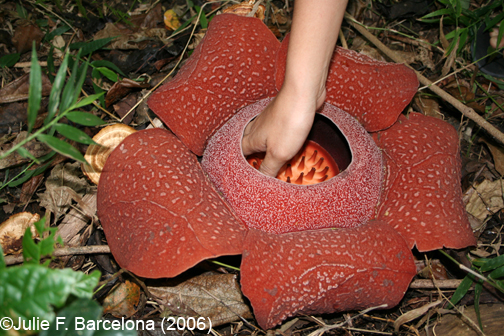
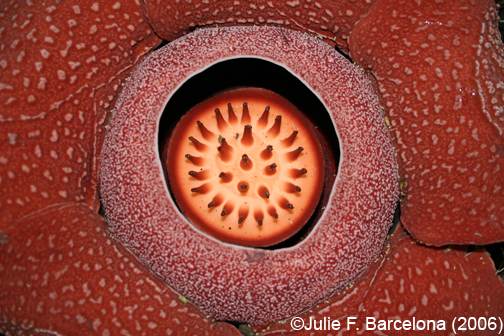
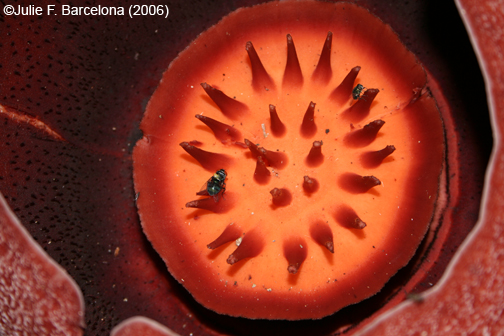
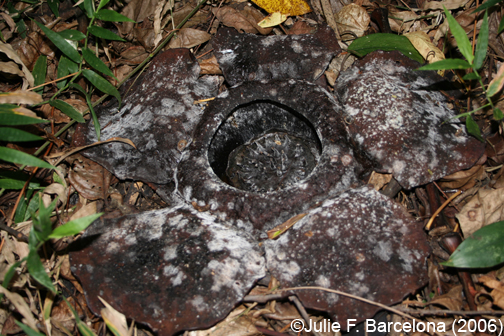
Mature buds 18-20 cm in diameter; cupule of mature flowers 2.5 cm high, 8.5 cm wide, bud scales to 11 cm long. Flowers (45-) 50-56 cm diam., 13-16 cm high when expanded. Perigone lobes orbicular, (10-) 12-18.5 (-20) X 14-22.5 cm, ca. 1 cm thick at base, dark-, reddish- or rusty-brown, becomming paler with age; upper surface warty, warts whitish, generally small and narrow, rather scattered, irregular in shape, whitish on a reddish-brown background in new bloom, undersurface smooth with white, roundish blots; margin entire to sinuate. Diaphragm 18-20 cm diam., to 7 mm thick, usually darker than the perigone lobes, upper surface appearing generally smooth, devoid of the white warts present on the perigone lobes, instead numerous smaller irregular white specks present all over, some occurring in groups that form two concentric rings around the rim, very prominent in newly opened flowers and fading with age, appearing brown on dark background when dry; the rim entire, whitish; orifice 9.5 - 10 cm diam. Disk ca. 9.5-12 (-14.3) cm in diam., ca. 6 mm thick, dome-shaped centrally, yellow-orange becoming reddish-orange at the periphery; rim of disk steeply raised with 1.0-1.5 cm raised part, enire to irregularly finely crenulate, reddish orange in new bloom; column to 2.5 cm above the base of the perianth tube, or ca. 6.5 cm from cupule base to the tip of disk, neck of column to 5.5 cm diam.; processes (17-) 20-27 (-31), usually arranged in 2-3 concenric rings pointing outward towards the rim, to 1.3-2.3 cm long, ca. 6 mm wide at base, reddish proximally, darker distally. Ramenta distributed all over the undersurface of the diaphragm, those above the perigone attachments generally stouter and reduced to tubercles, those below to ca. 2 mm long, becoming shorter towards the diaphragm base, simple or shallowly variably lobed. Male flowers with 19-24 anthers; anthers ca. 4.5 X 5 mm, anther cavity ca. 1.3 X 1.0 cm, densely hairy. Female flowers not known.
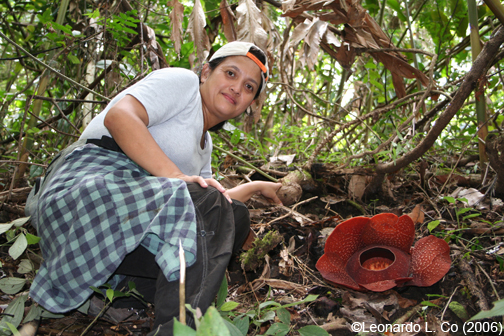
Albert Mamora Jr. posing with the flower of Rafflesia speciosa.

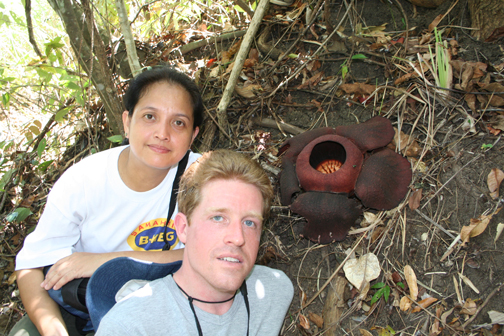
Albert Mamora and friend near the plants. Note the bamboo exclosure placed around some of the buds.

Close-up of the flower buds and an open flower in the background.

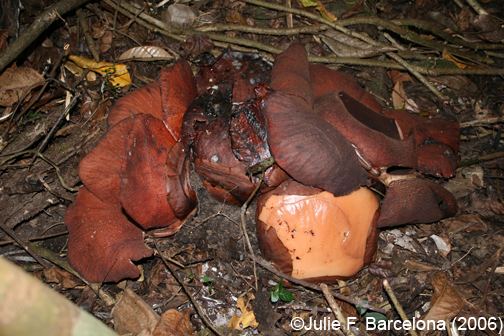
A fully opened flower and one that is senescing to the right.

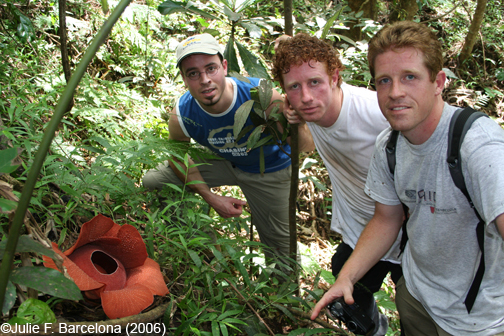
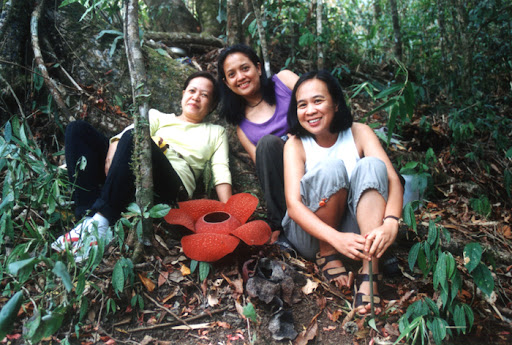
Julie Barcelona (center) and two members of The Antique Outdoors group posing with the flower of Rafflesia speciosa.

Julie Barcelona (for scale!) with a flower bud of R. speciosa.

Close-up of the flower bud of R. speciosa

A senescent flower of R. speciosa. Hopefully there will be some fruit production in these populations.

A fully opened flower of Rafflesia speciosa. Fantastic! Julie notes that the markings on the perigone lobes look like Rice Crispies!
SIUC / College of Science / Parasitic Plant Connection / Rafflesiaceae
URL: http://www.parasiticplants.siu.edu/Rafflesiaceae/Raff.SpNov.page.html
Last updated: 14-May-07 / dln