Tampilkan postingan dengan label rafflesia schadenbergiana. Tampilkan semua postingan

Minggu, 06 Juli 2008

Rafflesia schadenbegiana


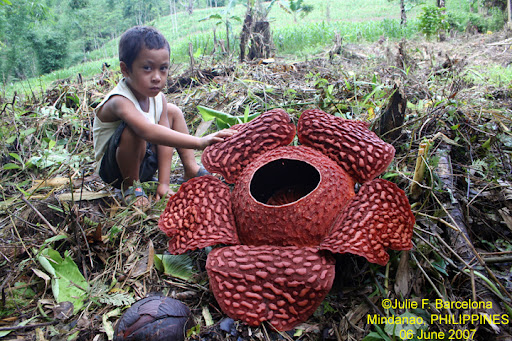
World's largest flower -- Rafflesia schadenbegiana was recently discovered in a CBFM area at Sitio Kalanganan, Barangay San Vicente, Baungon, Bukidnon. This is the only population of Rafflesia schadenbegiana that is currently flowering. The species was last seen in 1882 in Mt. Apo and was believed to be extinct until its recent find. The genus Rafflesia holds the record as the world’s largest flowers measuring as wide as 1 meter. It only flowers for 5 to 6 days at most before the petals blacken and flower withers. The odor is likened to rotting meat and attracts bluebottle flies for pollination. (PAWD/RPAO-10)

Source :
http://www.pia.gov.ph/default.asp?m=1&t=3&fi=070814-r10-rafflesia.jpg&mo=0708

Kamis, 27 Maret 2008

Photo of Rafflesia schadenbergiana


Rafflesia schadenbergiana Mindanao, PHILIPPINES


R. schadenbergiana Göppert HABITAT (margin of slash-and-burn area)

R. schadenbergiana Göppert BUD

R. schadenbergiana Göppert REDISCOVERED!!!

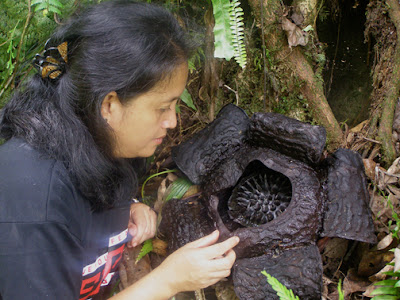
Julie F. Barcelona w/ R. schadenbergiana (CENTRAL MINDANAO)

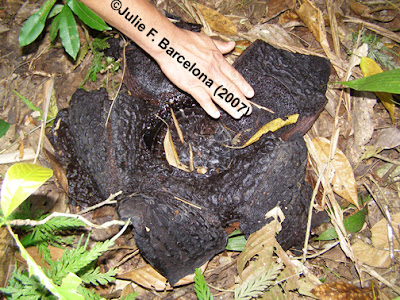
Rafflesia schadenbergiana Göppert REDISCOVERED!!! (CENTRAL MINDANAO)

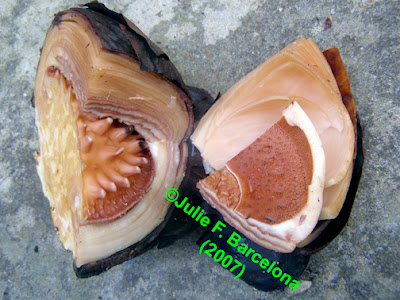
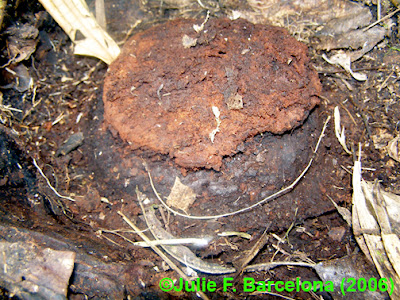
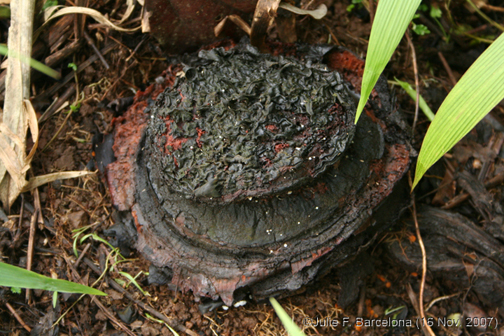
R. schadenbergiana Göppert FRUIT (CENTRAL MINDANAO)

Rafflesia schadenbergiana DEVELOPING FRUIT

Rafflesia schadenbergiana Mindanao, PHILIPPINES

J.F. Barcelona next to Rafflesia schadenbergiana Mindanao, PHILIPPINES


Rafflesia schadenbergiana Mindanao, PHILIPPINES

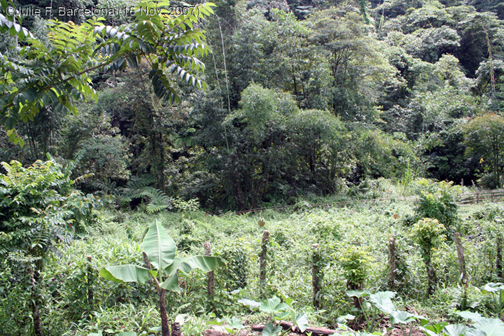
Rafflesia schadenbergiana HABITAT as of 16 Nov. 2007

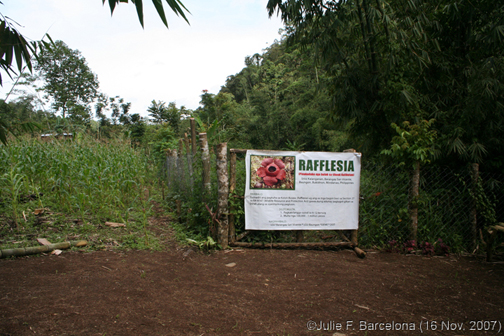
Rafflesia schadenbergiana CORRALED HABITAT as of 16 Nov. 2007

Rafflesia schadenbergiana HABITAT as of 16 Nov. 2007

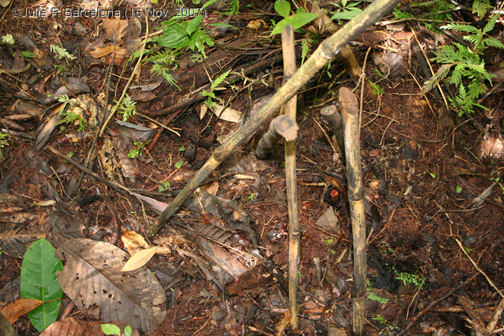
Rafflesia schadenbergiana PEGGED BU


Rafflesia schadenbergiana Göppert

Rafflesia schadenbergiana Göppert

This species was originally collected on the island of Mindanao (Mt. Apo) in the Philippines in 1882 (type attributed to either Hieronymus (Meijer, 1997; Nais, 2001) or Schadenberg and Koch (Merrill, 1923). Despite concerted efforts by field botanists, R. schadenbergiana had not been seen and was presumed extinct. Previous reports of R. schadenbergiana on Mt. Matutum (e.g. Nais, 2001) are erroneous (J. Barcelona, pers. comm.). A bud from Mt. Matutum examined at the Central Mindanao University in Bukidnon Province in 2002 represents a small-sized Rafflesia, too deteriorated for proper identification.

After 112 years since it was first discovered by the German ethnologist Schadenberg, R. schadenbergiana, was rediscovered on the island of Mindanao. In 1994 Pascal Lays found buds of R. schadenbergiana in South Cotabato Province on the island of Mindanao. His paper reporting this result has only recently been published. Moreover, Dr. Julie Barcelona reports on the discovery of yet another population of this rare species in Bukidnon (Flora Malesiana Bulletin, submitted; see also Julie's webpage HERE).

The morphological features of these flowers fit well with the original descriptions of this species (see below). Moreover, this is the largest flower among all the species of Rafflesia present in the Philippines, ranging from 52 to 70 cm in diameter. For these reasons, there is little doubt that this taxon is R. schadenbergiana. The Bukidnon "population" contains several buds, flowers, and fruits, but all are apparently parasitic on a single individual of the host vine Tetrastigma. For this reason, these plants are under extreme threat of extinction and concerted conservation efforts are required to maintain them for future generations.


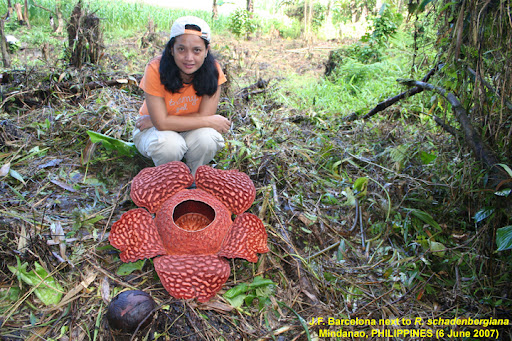
Julie Barcelona next to an open Rafflesia schadenbergiana flower and an unopened bud.


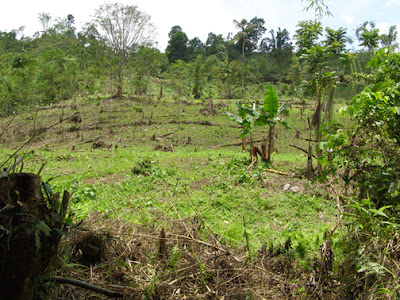
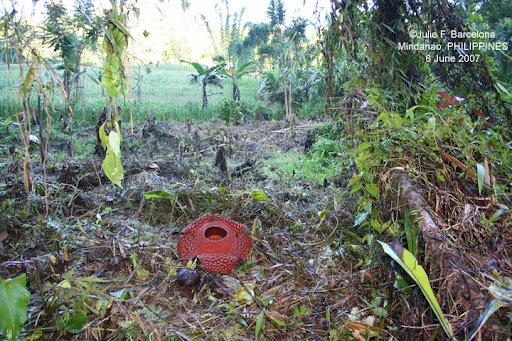
The habitat of Rafflesia schadenbergiana near an agricultural area. Photo by Julie Barcelona.


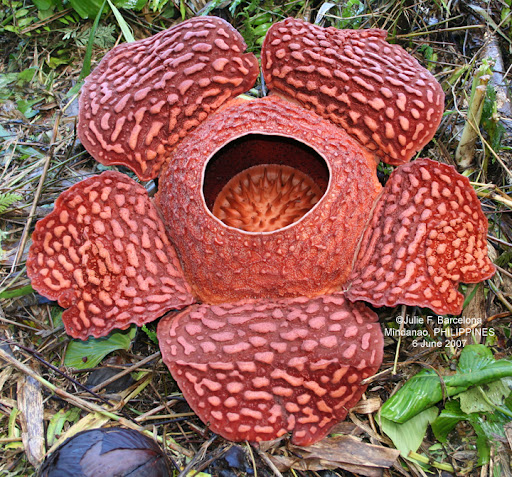
A fully open Rafflesia schadenbergiana flower. Photo by Julie Barcelona.


The next generation upon whom the survival of this magnificent species depends. Photo by Julie Barcelona.


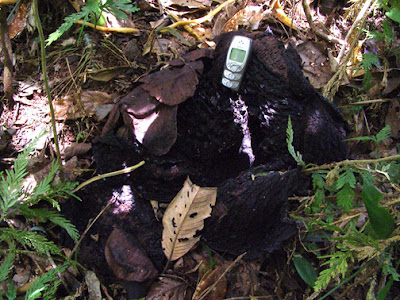
Two photos of the bud discovered in 1994 by Pascal Lays in South Cotabato Province on the island of Mindanao.
Rafflesia schadenbergiana bud


Description translated from the original German text (Koorders 1918) by Vanessa Ashworth

Warts of the perigone lobes medium sized, bumpy, often coalescing in a reticulate pattern. Perigone tube and the interior surface of the diaphragm covered almost to the margins with filiform ramenta with somewhat club-shaped swollen endings. A single annulus [coronal ring] protruding diagonally outward; the outer one represented by a level ring zone that is devoid of ramenta. Disc similar to previous species [R. hasseltii], as is the position of anthers in the male flower. Disc edge densely short-hairy above the anthers, as is the entire column. Anther cavities very flat, not extending half way down the column width, recessed on the upper side; ridges between them [the anther cavities] here narrow and pubescent at the edge. In the female flower the stigmatic ring forms a weak outer ridge; indented in front of the anther rudiments. Below each one of these [rudiments] there is a shallow area surrounded by hairs which is the rudiment of the anther cavity; column otherwise flat and everywhere short-hairy.

Description From Flora Malesiana treatment (W. Meijer, 1997)

Flower buds prior to expansion 16-20 cm in diameter, cupule 10-14 cm in diameter, bracts up to 17-18 cm long, 12-13 cm wide. Open flower about 80 cm in diameter. Ramenta on the inside of the flower tube 7-10 mm long, filiform, somewhat thickened at the apex, or branched, partly in fascicles. Diaphragm 6-8 cm from insertion to opening, opening 13-14 cm in diameter, margin with pinkish zone, lower face except the marginal zone provided with ramenta ca. 4-5 mm long. Perigone lobes 25-26 cm in diameter, with yellowish whitish warts which are laterally stretched, irregularly shaped, partly connected and about 4 or 5 [in number] across the middle part. Disk 12-13 cm in diameter, processes 30-50. Male flowers with 26-38 (-40) anthers.


SIUC / College of Science / Parasitic Plant Connection / Rafflesiaceae
URL: http://www.parasiticplants.siu.edu/Rafflesiaceae/Raff.schad.page.html
Last updated: 15-Sept-07 / dln

Senin, 03 Maret 2008

The Discovery of Rafflesia schadenbergiana in Central Mindanao

Contact Information
Julie F. Barcelona, Ph.D.
Philippine National Herbarium (PNH)
National Museum of the Philippines
P. Burgos St., Manila, PHILIPPINES
P.O. Box 2659
e-mail: barceljf@hotmail.com
Office Tel. (632) 522-5846


Measuring up to 80 cm in diameter, Rafflesia schadenbergiana, locally known as bó-o by the Bagobo tribe of Mindanao, is the largest flower of the Philippines and the third largest flower in the world. After its first discovery on the lower slopes of Mt. Apo in 1882 during an expedition led by Schadenberg and Koch, this rare treasure of Mindanao was not encountered again until Pascal Lays, a Belgian biologist, reported a population of R. schadenbergiana in South Cotabato Province in 1994. Recently, a new population has been found in Central Mindanao about 150 kilometers NNW of the locality where this species has first been found about 125 years ago. This population of R. schadenbergiana is unfortunately critically endangered, because it relies on a single Tetrastigma plant (the obligate host of Rafflesia species) found in a kaingin margin outside of the buffer zone of a protected area. The Rafflesia population is composed of several senescent flowers, buds, and fruits. Because of the vulnerability of this population to extinction, concerted conservation plan by the DENR, LGUs, scientists, and the local people should immediately be drafted.

Ongoing Projects

  • Pictorial Guide to Philippine Ferns and Fern Allies
  • Regional/Island Surveys of the Ferns and Fern Allies in the Philippines
  • Electronic Databasing of Philippine fern collections in world herbaria
  • Collection and Conservation Status of Philippine Endemic Ferns and Fern Allies
  • Studies on Philippine Rafflesia
Angiopteris palmiformis and Rafflesia speciosa

Publications

  • Barcelona, J.F., P.B. Pelser, A.M. Tagtag, R.G. Dahonog & A.P. Lilangan. In press. The rediscovery of Rafflesia schadenbergiana Göpp. ex Hieron. (Rafflesiaceae). Flora Malesiana Bulletin.
  • Barcelona, J.F., P.B. Pelser & M.O. Cajano. 2007. Rafflesia banahaw (Rafflesiaceae), a new species from Luzon, Philippines. Blumea 52: 345-350.
  • Barcelona, J. F., Cajano, M. O. & A. S. Hadsall. 2006. Rafflesia baletei, another new Rafflesia (Rafflesiaceae) from the Philippines. Kew Bull. 61(2): 231-237.
  • Barcelona, J. F., N. E. Dolotina, G. S. Madroñero, W. G. Granert & D. D. Sopot. 2006. The ferns and fern allies of the karst forests of Bohol Island, Philippines. Amer. Fern J. 96(1): 1-20.
  • Barcelona, J. F. 2005. Noteworthy fern discoveries in the Philippines at the turn of the 21st Century. Fern Gaz.17(3): 139-146. Proceedings of the international symposium on the Ferns for the 21st Century held at the Royal Botanic Garden Edinburgh, Scotland. 12-16 July 2004.
  • Barcelona, J. F. 2004. Collection and conservation status of pteridophytes in Panay Island, Philippines. Philipp. Scient. 41:57-73.
  • Barcelona, J. F. 2003. The Taxonomy and ecology of the pteridophytes of Mt. Iraya & vicinity, Batan Island, Batanes Province, Northern Philippines, in Pteridology in the New Millenium (Chandra and Srivastava, eds). Kluwer Academy Publishers. The Netherlands, 299-325.
  • Barcelona, J. F. 2003. Preliminary report on the ferns and fern allies (pteridophytes) of Mt. Bali-it, Balbalasang-Balbalan National Park, Kalinga, Northern Luzon, Philippines. Sylvatrop: The Technical Journal of Philippine Ecosystems and Natural Resources 13(1&2): 81-92.
  • Barcelona, J. F. and E. S. Fernando. 2002. A new species of Rafflesia (Rafflesiaceae) from Panay Island, Philippines. Kew Bull. 57: 647-651.
  • Barcelona, J. F. 2002. Philippine pteridophyte collections as a resource for conservation planning. Proceedings of the “International Symposium on the Fern Flora Worldwide: Threats and Responses” sponsored by the British Pteridological Society and IUCN- Species Survival Commission.” Fern Gaz. 16(6, 7 & 8): 307-312.
  • Barcelona, J. F. & M. G. Price. 1999. A new Philippine Goniophlebium. Fern Gaz. 15(7). 261-264.
  • Barcelona, J. F. Hernaez, B. & M. G. Price. 1996. Philippine Schizaea. Asia Life Sciences 5(1): 27-34.
http://juliebarcelona.blogspot.com/

Rafflesia schadenbergiana Göppert

This species was originally collected on the island of Mindanao (Mt. Apo) in the Philippines in 1882 (type attributed to either Hieronymus (Meijer, 1997; Nais, 2001) or Schadenberg and Koch (Merrill, 1923). Despite concerted efforts by field botanists, R. schadenbergiana had not been seen and was presumed extinct. Previous reports of R. schadenbergiana on Mt. Matutum (e.g. Nais, 2001) are erroneous (J. Barcelona, pers. comm.). A bud from Mt. Matutum examined at the Central Mindanao University in Bukidnon Province in 2002 represents a small-sized Rafflesia, too deteriorated for proper identification.

After 112 years since it was first discovered by the German ethnologist Schadenberg, R. schadenbergiana, was rediscovered on the island of Mindanao. In 1994 Pascal Lays found buds of R. schadenbergiana in South Cotabato Province on the island of Mindanao. His paper reporting this result has only recently been published. Moreover, Dr. Julie Barcelona reports on the discovery of yet another population of this rare species in Bukidnon (Flora Malesiana Bulletin, submitted; )
The morphological features of these flowers fit well with the original descriptions of this species (see below). Moreover, this is the largest flower among all the species of Rafflesia present in the Philippines, ranging from 52 to 70 cm in diameter. For these reasons, there is little doubt that this taxon is R. schadenbergiana. The Bukidnon "population" contains several buds, flowers, and fruits, but all are apparently parasitic on a single individual of the host vine Tetrastigma. For this reason, these plants are under extreme threat of extinction and concerted conservation efforts are required to maintain them for future generations.

Description translated from the original German text (Koorders 1918) by Vanessa Ashworth


Warts of the perigone lobes medium sized, bumpy, often coalescing in a reticulate pattern. Perigone tube and the interior surface of the diaphragm covered almost to the margins with filiform ramenta with somewhat club-shaped swollen endings. A single annulus [coronal ring] protruding diagonally outward; the outer one represented by a level ring zone that is devoid of ramenta. Disc similar to previous species [R. hasseltii], as is the position of anthers in the male flower. Disc edge densely short-hairy above the anthers, as is the entire column. Anther cavities very flat, not extending half way down the column width, recessed on the upper side; ridges between them [the anther cavities] here narrow and pubescent at the edge. In the female flower the stigmatic ring forms a weak outer ridge; indented in front of the anther rudiments. Below each one of these [rudiments] there is a shallow area surrounded by hairs which is the rudiment of the anther cavity; column otherwise flat and everywhere short-hairy.

Description From Flora Malesiana treatment (W. Meijer, 1997)

Flower buds prior to expansion 16-20 cm in diameter, cupule 10-14 cm in diameter, bracts up to 17-18 cm long, 12-13 cm wide. Open flower about 80 cm in diameter. Ramenta on the inside of the flower tube 7-10 mm long, filiform, somewhat thickened at the apex, or branched, partly in fascicles. Diaphragm 6-8 cm from insertion to opening, opening 13-14 cm in diameter, margin with pinkish zone, lower face except the marginal zone provided with ramenta ca. 4-5 mm long. Perigone lobes 25-26 cm in diameter, with yellowish whitish warts which are laterally stretched, irregularly shaped, partly connected and about 4 or 5 [in number] across the middle part. Disk 12-13 cm in diameter, processes 30-50. Male flowers with 26-38 (-40) anthers.

ht*p://www.parasiticplants.siu.edu/Rafflesiaceae/Raff.schad.page.html

Photo of Rafflesia schadenbergiana

28 September 2007
Rediscovery of Rafflesia schadenbergiana

by
Prof Dr Kamarudin Mat-Salleh


Fr. Sirenio "Toto" Jaranilla of Baungon, Bukidnon, Mindanao, the Philippines wrote to me with attachment of splendid recent photos of Rafflesia schadenbergiana Goeppert . I am aware of this rediscovery since the report was sent bt Dr. Julie Barcelona to Leiden to be published.


These photos were taken 7th Sep 2007 from the sites that was extremely vulnerable, so I won't disclose them. The photo of ramenta is probably the only photo available (in the internet?).

The rare Rafflesia schadenbergiana was thought to be long extinct, together with 3 other species of Rafflesia from Kutai, Kalimantan, since it was seen or collected since their discoveries. This poorly known species was last seen in 1881 by ethnologist Alex Schadenberg in Mount Apo, Mindanao. Several attempts by Dr Jamili Nais, Dr Todd Barkman in late 1990's and botanists in Manila could not trace it in Mt Apo, but according to Jamili, there are previous reports of buds in nearby Mt. Matutum. This was later said to be another unknown species. Because of this situation, we don't really know the morphology of the species, and most of us rely on Nais's artist interpretation which look like the larger size of Rafflesia pricei of Sabah.


photos courtesy of J Nais from his rafflesia book


In 1994 entomologist Pascal Lays found buds of R. schadenbergiana in South Cotabato Province, Mindanao and posted a coment in the internet (i forgot the site) and my emails to him left unanswered. However he finally publish his report with a dissection of a but it was difficult to ascertain (I lost this paper! whoever from RRMT borrowed it please return, ASAP - this is an order!). Lays's and Julie's photos is available in Nickrent's page

ht*p://rafflesia-in-bloom.blogspot.com/2007/09/rediscovery-of-rafflesia.html


Template Design By:
SkinCorner/laudean